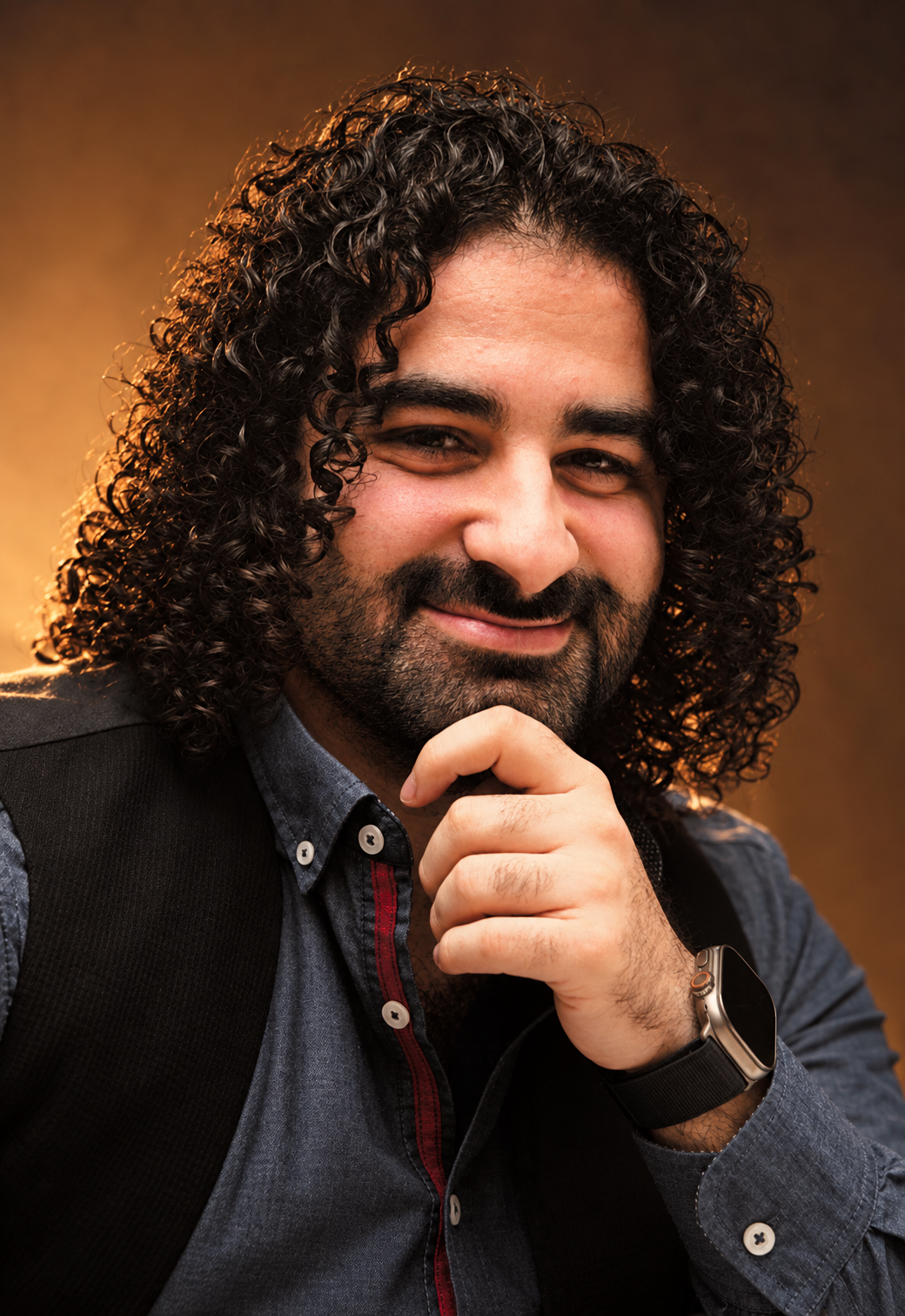
Gökdeniz Gülmez
Portrait of Gökdeniz Gülmez
Open source · Apple Silicon

Open-source contributor · Apple MLX

Gökdeniz
Gülmez

Systems Engineer at Computacenter, specialising in machine learning engineering and MLOps. Machine Learning Research Engineer in my spare time.

I build machine-learning systems, software that learns patterns from examples—and help take them from experiments into reliable services. That work is called MLOps. In my free time, I contribute to open source and research ways to run and train AI on Apple chips. I’m a key contributor to Apple’s MLX toolkit and MLX-LM, which make it easier to run and train language models locally. I also maintain the training engine for models that work with images and text, and develop my own J.O.S.I.E. AI model family.

Apple chips Apple’s MLX tools Training language models MLOps Local AI

01 / About

I help run and train AI
on Apple chips.

At Computacenter, I work as a System Engineer focused on machine-learning engineering and MLOps—the work of deploying, monitoring and maintaining software that uses AI. Outside work, I contribute to open source and conduct ML research. Apple’s MLX tools let developers build, train and run models on Apple chips. My contributions help those tools support more models and make it easier to teach them new tasks, including models that understand both images and words.

01 / SystemsML engineering & MLOps
02 / RuntimeRun models on Apple devices
03 / TrainingAdapt models to new tasks
04 / ResearchHow models work and specialize

02 / Upstream

I make AI work
on Apple chips.

MLX is Apple’s open-source toolkit for machine learning. The tools around it help people run and train AI models directly on Apple chips. Here are some of my credited contributions.

01Core framework · MLX

New training primitives

I added Muon, a method for updating a model as it learns, and ReLU², a small mathematical function used inside neural networks. Both are credited in MLX’s contributor acknowledgements.

See MLX acknowledgements
02Language models · MLX-LM

Support for 20+ model designs

MLX-LM is Apple’s toolkit for running and training text-generating AI models. I helped it support more than 20 model designs, and added ways to train every learned value in a model, choose between training methods, and track experiments with Weights & Biases, a tool for recording and comparing training runs. A model design is its internal blueprint; the list below links to the original model files and code changes.

Read MLX-LM credits
03Vision-language · MLX-VLM

Training backend maintainer

MLX-VLM works with models that handle both images and words. I’m the main maintainer of its training engine—the code that runs the learning process. I rebuilt that engine and added ORPO, a way to teach models from examples of preferred and less-preferred answers.

Explore MLX-VLM
04Examples · MLX Examples

Workflows people can run

MLX Examples offers practical, runnable demonstrations. Its acknowledgements credit my work bringing several models to the examples and adding full training, which adjusts all of a model’s learned values.

Read MLX Examples credits
Model architecture support · MLX-LM

20+ model variants across 15+ organizations.

MLX-LM credits my work on these 25+ model variants from 15+ organizations. An architecture is a model’s internal design; weights are the learned values that let it work. “Weights” links to original model files. “PR” means pull request: a proposed code change and its review.

    DeepSeek's DeepSeek v4.1, State-Space's Mamba v1 and Mamba v2, Z.ai & THUKEG's GLM, GLM4, GLM5 (GLM MoE DSA), Rednote dots.llm1, Baidu's Ernie4.5 MoE, inclusionAI's Bailing MoE e.g. Ling-family, Bailing MoE Linear e.g. Ling-Linear-family, Klear team - Kuaishou Technology's Klear, AI21 Lab's Jamba IBM's Granite MoE, Mistral AI's Mistral4, Meituan's LongCat, Nvidia's Nemotron H, Swiss-AI's Apertus, Nikity's Lille130m, Alibaba Qwen's Qwen3Next, Tele-AI's TeleChat3, and Allenai's OLMoE and Olmo 3; Helped add support for the following model architectures: Alibaba Qwen's Qwen3 & Qwen3MoE); Added support for the following training algorithms: Full Weight Fine-Tuning, and the Muon optimizer; Added support for the following other features: Multiple Optimizers to choose for training, and reporting training metrics to WandB (Weights & Biases).
  • OpenBMB

    MiniCPM · MiniCPM3

  • Alibaba Qwen

    Qwen3Next

  • Alibaba Qwen

    Qwen3

  • Alibaba Qwen

    Qwen3.5

  • Kyutai

    Helium

  • DeepSeek

    DeepSeek v4.1

  • State Space

    Mamba v1 · Mamba v2

  • Z.ai · THUKEG

    GLM · GLM4 · GLM5 (MoE DSA)

  • Rednote

    dots.llm1

  • Baidu

    ERNIE 4.5 MoE

  • inclusionAI

    Bailing MoE (Ling) · Bailing MoE Linear (Ling-Linear)

  • Klear · Kuaishou

    Klear

  • AI21 Labs

    Jamba

  • IBM

    Granite MoE

  • Mistral AI

    Mistral4

  • Meituan

    LongCat

  • NVIDIA

    Nemotron H

  • Swiss AI

    Apertus

  • Nikity

    Lille130m

  • Alibaba Qwen

    Qwen3Next · Qwen3 · Qwen3MoE

  • Tele-AI

    TeleChat3

  • AllenAI

    OLMoE · OLMo 3

Mamba v3 is still in review — weights · open PR #1021.

Qwen3 note: PR #42 closed before it was merged. The project credits my help on Qwen3 and its version built from specialist submodels; PR #199 is a later accepted update to that version.

Read the MLX-LM acknowledgements

03 / Research

Researching how
models learn and act.

Preprint · 2026

DynaMoE

A model with several specialist parts that can activate different experts for different inputs. DynaMoE studies whether choosing those specialists dynamically can help a model use its computing resources more efficiently.

Read the paper
Preprint · 2025

Gabliteration

A method for changing selected model behaviors by editing its learned values, while checking that other abilities still work well.

Read the paper
AI training method · ongoing

Learning from preferred answers

Directional and Similarity-aware Latent Alignment (DSLA) studies how feedback about better answers can also shape the patterns a model forms internally while processing text.

Read the paper

04 / Model family

J.O.S.I.E. —
models with character.

My open model family · Hugging Face

Reasoning-first models, built locally.

J.O.S.I.E. is my family of downloadable AI models, exploring reasoning, honesty and independent judgment. J.O.S.I.E.-2 includes models with 2, 4 and 9 billion learned values, trained on Apple chips. Smaller versions, with fewer bits used to store each learned value, need less memory and are easier to run on a personal computer.

Read the J.O.S.I.E.-2 research note Visit the J.O.S.I.E. project page

05 / Selected work

Tools, models
& experiments.

Vision-language training

MLX-VLM

Training tools for AI models that work with both images and text. I maintain the code that runs their training and adaptation workflows.

Explore the project
Native Mac app

MLX-LoRA-Studio

An open-source Mac app for adapting language models to new tasks, checking their results and managing models on Apple chips.

Explore the project
Model research

J.O.S.I.E.

A personal model family exploring small language models, reasoning and assistant behavior, with releases and research notes on Hugging Face.

Explore J.O.S.I.E.
Interpretability

MLX-LM-LENS

A research tool for looking inside language models: how they represent words, which parts of the input they focus on, and how information moves through them.

Explore the project
Local AI

Local NotebookLM

A notebook that uses your PDFs as the source for summaries and creates audio versions with language and speech tools you choose.

Explore the project
Model editing

Gabliteration

Research and tools for finding model edits that change selected behaviors while aiming to keep other abilities intact.

Explore the project
MLX research

MLX-KAN

An implementation of Kolmogorov–Arnold Networks, an alternative model design built from simple, learnable functions, using Apple’s MLX toolkit.

Explore the project

06 / Career

Career

Computacenter

System Engineer

System Engineer focused on building machine-learning software and keeping it reliable after deployment. MLOps covers the tools and practices for shipping, monitoring and maintaining AI systems.

In my free time, I contribute to open source and pursue ML research and engineering.

07 / References

Upstream credits,
papers & releases.

08 / Elsewhere

Follow the work
where it lives.